The record-breaking success of Farnborough International Airshow 2026 has provided another clear signal that the global aerospace industry has entered a sustained period of production growth, with manufacturers now focused on one critical question: how to deliver more aircraft without creating greater efficiency throughout the supply chain.
The five-day event attracted 141,580 visitors from 136 countries, a 41% increase on the previous show, while commercial announcements exceeded $84.7 billion, including 353 aircraft orders and 904 engine orders. For suppliers across the aerospace sector, the scale of activity reflected growing confidence in long-term production rates across both commercial aviation and defence.
For Velocity Composites plc, the momentum seen at Farnborough reinforces the increasing importance of digitally connected supply chains capable of supporting higher build rates while helping manufacturers improve productivity, reduce inventory and maximise the utilisation of high-value composite materials.
As aircraft production accelerates, manufacturers are increasingly looking beyond individual components towards the efficiency of the entire manufacturing ecosystem. Every stage of the composite materials journey—from procurement and inventory management through to engineered kitting, logistics and production support—offers opportunities to improve operational performance while supporting sustainability objectives.
James Eastbury, Chief Customer Officer at Velocity Composites, said:
“The discussions throughout Farnborough reflected an industry that is planning confidently for long-term production growth. As build rates increase, manufacturers are looking for supply chain partners that can help them scale efficiently while maintaining quality, traceability and sustainability. That’s exactly where digitally managed composite material supply chains create real value.”
Composite materials represent some of the most technically advanced and valuable consumables used within modern aircraft manufacture. Managing those materials efficiently becomes increasingly important as production volumes rise across multiple aircraft programmes simultaneously.
Velocity’s integrated service model combines global procurement, proprietary digital inventory management, engineered material kits, logistics and on-site customer support into a single connected solution. Rather than customers holding significant volumes of stock to protect production schedules, materials are managed dynamically, converted into production-ready kits and delivered precisely when required.
The approach allows aerospace manufacturers to reduce inventory levels while maintaining confidence that materials will be available exactly where and when they are needed.
“When production is increasing, visibility becomes incredibly important. Having accurate digital oversight of material availability, inventory levels and future demand allows customers to reduce unnecessary stockholding while keeping programmes moving efficiently. That benefits productivity, working capital and sustainability simultaneously” said Eastbury.
Velocity’s engineered kitting capability further enhances manufacturing efficiency by preparing composite materials into ready-to-use kits tailored to specific aircraft structures and manufacturing operations. Operators receive precisely the material required for each assembly, reducing manual preparation, improving repeatability and helping minimise material waste throughout production.
Supporting this process is Velocity’s proprietary digital manufacturing technology, which optimises cutting layouts across multiple programmes using advanced nesting software. By maximising material yield while maintaining full batch traceability, manufacturers gain greater value from every roll of composite material processed.
The result is improved material utilisation, reduced scrap generation and greater manufacturing consistency—benefits that become increasingly significant as aerospace production continues to expand.
Alongside manufacturing efficiency, Velocity’s integrated logistics model helps customers simplify increasingly complex global supply chains. Temperature-controlled transportation, coordinated delivery scheduling and digitally managed inventory ensure sensitive composite materials remain fully compliant while reducing unnecessary handling and storage.
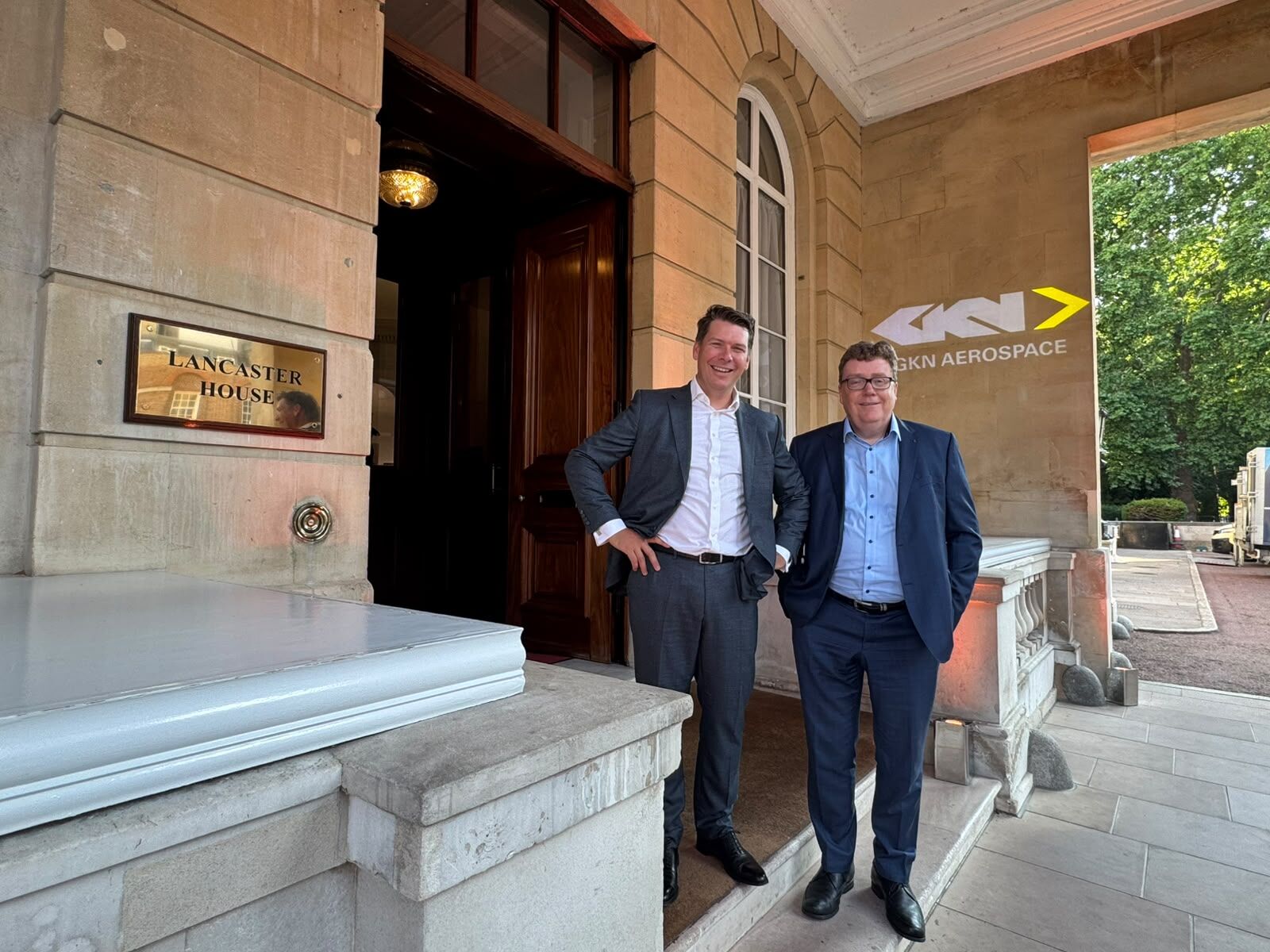
The airshow also provided an opportunity for Velocity’s leadership team to strengthen relationships with customers and industry partners throughout the week, culminating in Chief Executive Officer Jon Bridges and Chief Customer Officer James Eastbury attending the GKN Aerospace Farnborough International Reception at Lancaster House. Bringing together senior figures from across the global aerospace sector, the reception reflected the collaborative partnerships that continue to underpin innovation and long-term programme success.
Eastbury added:
“Aircraft manufacturers are looking for supply chains that are every bit as advanced as the products they’re building. Digital connectivity gives organisations the information they need to make faster, better-informed decisions while improving resilience across increasingly complex global programmes.”
Velocity’s capabilities are supported by internationally recognised aerospace quality accreditations, including AS9100, AS9120 and Nadcap, providing the levels of quality assurance, traceability and process control demanded by leading aerospace OEMs and Tier One manufacturers worldwide.
With the record attendance and commercial activity at Farnborough underlining confidence across the global aerospace market, the industry’s attention is increasingly turning towards the technologies and supply chain partnerships that will support the next generation of production growth. For Velocity Composites, that means continuing to combine digital innovation, engineered composite material solutions and integrated supply chain management to help aerospace manufacturers increase output with greater efficiency, visibility and control.